Nio Esseia
The DispossessedNio Esseia is A-Io’s immense capital, a city of five million people whose monumental institutions and carefully arranged receptions initially present the country to Shevek as prosperous and orderly. As he encounters its official showcases, neglected Old Town, and a vast demonstration ending in state violence, the city’s contrasting spaces expose the unrest and inequality hidden behind that display. It becomes the place where political ideas about Anarres cease to be distant abstractions: workers and dissidents recognize Shevek as living evidence that society can be organized without government, police, or economic exploitation.
Setting and First Impressions
When Shevek first reaches the city, the encounter is mediated by ceremony and security. After stumbling from the ramp onto the new world, he is surrounded by photographers, dignitaries, professors, and security agents. The news presents him as “The First Man from the Moon,” while the people escorting him hurry him into a limousine and announce that they will take him directly to the University rather than expose him to the crowds. From inside the car, he sees the towers and lights through fog, but cannot distinguish the High Court from the National Museum, the Directorate, or the Senate. The city is already both a place and a managed image: visible in fragments, interpreted for him by his escorts, and separated from public contact by the arrangements made around his arrival.
That first view is dominated by scale and hard surfaces. Towers climb into mist, trains streak overhead, and walls of stone and glass face the traffic below. The impression of a city full of movement does not resolve into familiar human encounters; from Shevek’s vantage, there are “No faces.” Later, as the car leaves the river valley and enters wooded countryside, he marvels at the apparent abundance of trees. The contrast makes Nio Esseia’s lights and stone architecture feel less like the whole world than like the controlled threshold through which he is being introduced to it.
The Capital on Display
The University is fifty kilometers from Nio Esseia, but Shevek is taken into the capital frequently for receptions. Their politeness and elaborate dress do not make him feel at ease: the conversation seems uninteresting, the smiles anxious, and the lavish clothing, food, drinks, furnishings, and ornaments appear to carry a lightness absent from the hosts’ manner. The receptions make abundance conspicuous, while leaving the human terms of life largely unspoken.
The sightseeing program gives that abundance an institutional frame. Nio Esseia is identified as a city of five million—one quarter of Anarres’s population—and Shevek is shown Capitol Square and the Directorate’s high bronze doors. He witnesses a debate in the Senate and a committee meeting of the Directors, visits the Zoo and the national museums, hears uniformed schoolchildren sing A-Io’s anthem, and tours an electronic-parts factory, an automated steel mill, and a nuclear-fusion plant. A government-built housing development is offered as evidence of public provision; a boat trip down the Sua Estuary displays shipping from across the planet. The sequence is designed to make the city’s political and productive order legible as a success story.
A visit to the High Courts unsettles that confidence. Shevek spends a day listening to civil and criminal cases and leaves bewildered and appalled, though his guides insist that he should see whatever interests him. He also asks, diffidently, to visit the place where Odo was buried. At the old cemetery in the Trans-Sua district, news photographers are allowed to record him beside the plain, well-kept tombstone bearing Odo’s name and dates. Amid the city’s displays of state power and industrial achievement, the grave links the capital to the revolutionary tradition that its official tours cannot contain.
The City Behind the Showcase
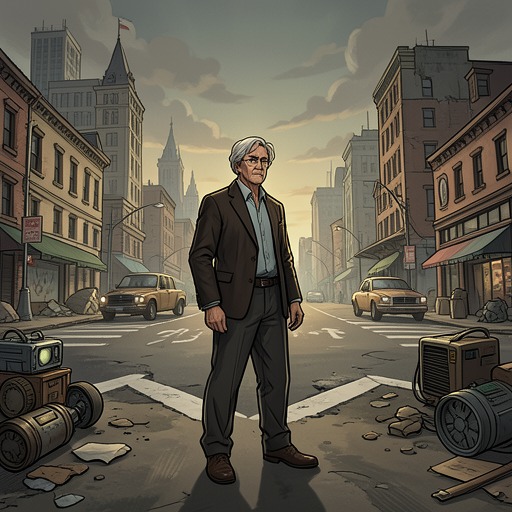
A different Nio Esseia emerges when Shevek uses a map and the subway to reach Old Town. His costly day with Vea has consumed most of his ready cash, and the taxi into the city takes ten more units. Joking Lane is absent from his map, so he gets off at Old Town’s central stop. The spacious marble station does not prepare him for the streets above: in the fine, dark rain there are no working streetlights, shopfronts are shuttered, refuse litters the greasy pavement, and one burned-out storefront remains black and broken. People move past as hurried shadows. An old woman coming up from the subway appears, at first, to be old; in the entrance light Shevek sees that she is not yet thirty. He asks her for directions, but she walks on without answering.
This passage through Old Town punctures the smooth itinerary of official hospitality. The city that had been presented through museums, factories, courts, and government housing now registers through broken shopfronts, exhausted bodies, and the difficulty of finding a street that is not on the map. The contrast is not simply between two views of the same capital: access itself is unequal. Shevek had been guided through the places chosen for him; in Old Town he has to navigate alone, and the woman he asks has neither the energy nor inclination to assist him.
The political conditions of the city become explicit in conversation with Maedda. A demonstration has been announced for three days later, protesting the draft, war taxes, and rising food prices. Maedda cites four hundred thousand unemployed people in Nio Esseia and argues for a general strike and mass demonstrations, recalling the Ninth Month Strike led by Odo. The movement works with other political groups but describes itself as anti-centralist. For its members, Anarres is not merely a remote experiment: the possibility of a society without government, police, or economic exploitation has sustained hope for generations. Maedda explains that the government has kept Shevek at Ieu Eun, away from public meetings and ordinary people, because he embodies that possibility as well as carrying a valuable scientific theory. The city’s restricted access to him is therefore political containment, not just ceremonial protocol.
Capitol Square and the Limits of Order
The announced protest fills Capitol Square on a scale that defeats individual calculation. Perhaps one hundred thousand people are present, perhaps twice that number. The crowd gathers, marches, sings, and listens in the bright noon, while amplified speeches echo from the Senate and Directorate facades over the immense murmur of the assembly. Shevek stands with Maedda and the others on the Directorate steps, facing the same bronze doors he had previously seen as part of a guided tour. Now the square is not a civic attraction but a collective political space, and the buildings that signified government become the backdrop against which people make their demands.
Shevek’s place in the demonstration has changed too. He is no longer the carefully secluded visitor carried between official appointments. Maedda’s companions have connected him with the tradition that gives the protest its political meaning, and he speaks among the demonstrators. The crowd’s scale makes it impossible to reduce the moment to a count of separate individuals; as a mass, it acts together, yet its members remain unquantifiable. In that setting, speaking and listening draw close: Shevek recognizes his words as continuous with what he had already said from his own isolation, now voiced in the language of a public gathered around him.
The demonstration ends in repression. During the violence, Shevek helps a wounded demonstrator who had been standing near him and Maedda. As the crowd is driven away from Capitol Square by police and armored cars, he supports the injured man for several blocks. With the man weakening and no safe public refuge available, Shevek breaks the hasp and padlock on a warehouse basement door using a loose piece of paving stone. The doors of the privately owned building had been locked; once inside, he finds crates, washtubs, and a fire hose. His companion faints, and Shevek uses water from the hose to wash the badly damaged hand, where gunfire has torn away two fingers and mangled the palm and wrist. The episode turns the city’s property system into an immediate physical barrier, then makes shared need the reason to cross it.
Political Meaning
Nio Esseia concentrates the novel’s contrast between public prosperity and suppressed conflict. Its modern factories, courts, museums, shipping, and government housing are real features of the capital; so are the unemployment, neglected streets, rising prices, political surveillance, and armed suppression that the official itinerary keeps out of view. The city cannot be reduced to either its elegant display or its deprivation. Its central tension lies in the distance between what the state can exhibit and what its inhabitants demand.
That tension also gives the city a particular importance in the relationship between A-Io and Anarres. The government brings Shevek to the capital for scientific work while keeping him away from the people who might hear what his society represents. Yet the existence of Anarres has already entered Nio Esseia’s political imagination: dissidents invoke it as proof that another social order is possible, and the crowd gathers at the very buildings that stage A-Io’s authority. In the capital, the abstract question of social organization takes bodily form—in who may enter a meeting, who is left in the dark streets, who can occupy the square, and who must break a lock to shelter the wounded.